Searching “scooter for rent near me” in Manila will surface aggregator listings, peer-to-peer apps, and a handful of actual rental shops — but most results skip the details that matter: insurance coverage, what happens if something goes wrong, and whether your foreign license is actually valid. This guide covers all of it, from choosing the right bike to understanding what you’re signing up for before you hand over your deposit.
Why Renting a Scooter Makes Sense in Manila
Manila’s traffic is brutal in a car, manageable on a motorcycle or scooter. A rented scooter lets you filter through gridlock, park almost anywhere, and reach destinations that Grab and taxis make expensive through surge pricing and long waits. For tourists, a scooter unlocks a version of Manila that public transport simply cannot reach — side-street food stalls, barangay markets, and the faster routes between Makati, BGC, and Intramuros.
For longer stays or business travelers, a weekly or monthly rental from a reputable shop typically works out far cheaper than daily Grab usage, especially once you’re comfortable riding in local traffic.
What Type of Scooter Should You Rent?
The Philippine rental market breaks down into a few clear categories. Understanding the difference helps you pick the right bike and avoid paying for engine displacement you won’t use.
Automatic Scooters (125cc–160cc)
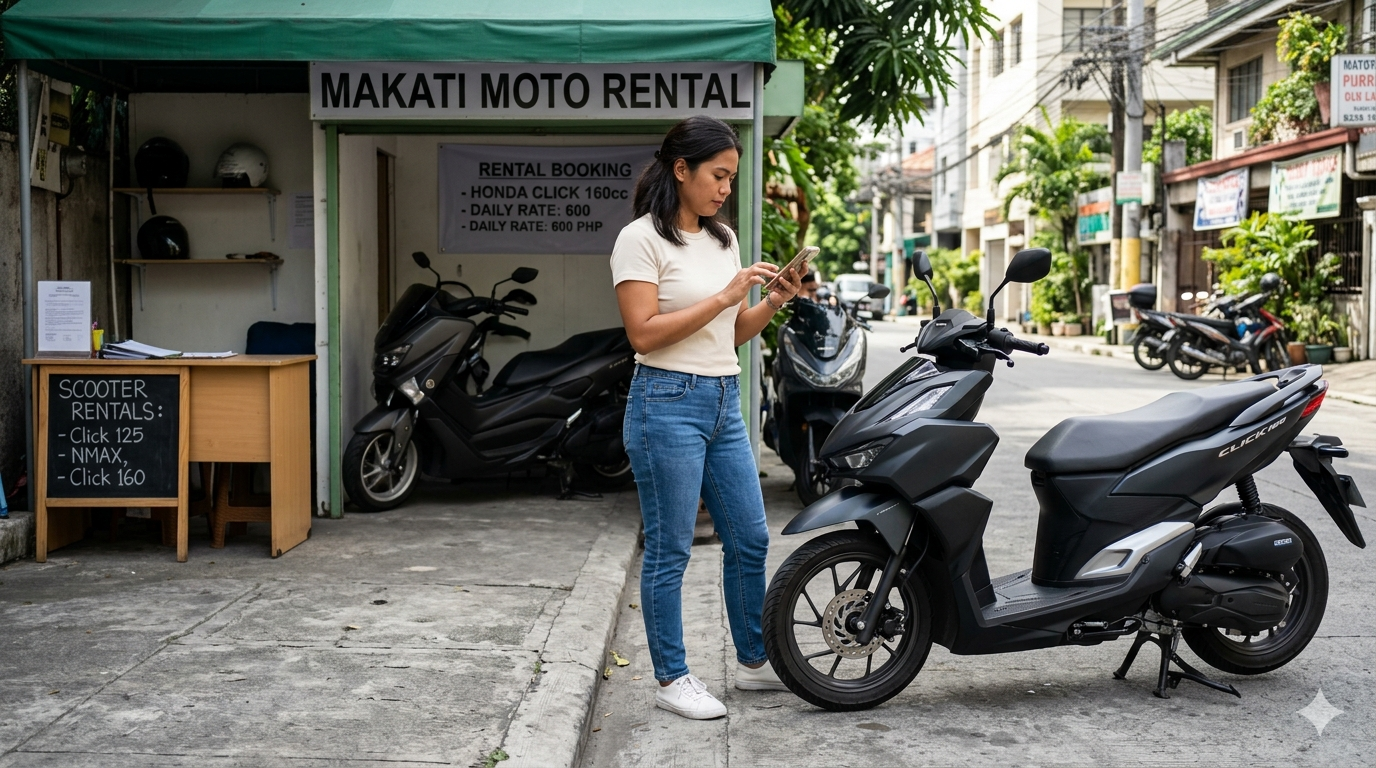
The Honda Click 125, Honda Click 160, Yamaha NMAX V2, and Honda PCX are the most rented bikes in Metro Manila. They’re automatic, fuel-efficient, comfortable in city traffic, and have underseat storage for a day bag. These bikes are appropriate for both beginners and experienced riders navigating urban roads.
One important rule: scooters under 400cc are not permitted on Philippine expressways (NLEX, SLEX, CAVITEX, etc.), regardless of your license type. For all city and highway riding, they’re perfectly legal. If you plan to use toll expressways, you’ll need a 400cc+ bike.
Mid-Range Bikes (155cc–160cc)
The Yamaha WR155R and Honda ADV 160 sit between city scooter and adventure bike. The WR155R is more off-road oriented; the ADV 160 is a maxi-scooter that handles highway riding well. Both work for riders who want more comfort and slightly more power for longer intercity trips.
Large Displacement Bikes (400cc–650cc)
If you plan to use expressways or want to ride beyond Metro Manila into the provinces at higher sustained speeds, the Kawasaki Dominar 400, Kawasaki Z400, and Kawasaki Vulcan 650S are available. These bikes require a motorcycle license with the appropriate restriction code. They’re also the only rental category that can legally use Philippine toll roads.
For current rates and bike availability, check the Our Rentals page — pricing varies by model and rental duration, with progressively larger discounts for weekly and multi-week bookings.
License Requirements: What You Actually Need
This is where most guides — and many rental shops — get it wrong. Here is what the rules actually say.
For Filipino Riders
You need a valid LTO-issued driver’s license with a motorcycle restriction code (Restriction 1 for personal use). A car-only license does not cover motorcycles, even for small automatic scooters. If you don’t have a motorcycle restriction yet, you can add it to your existing license through the LTO.
For Foreign Visitors
According to the Land Transportation Office (LTO) and Republic Act No. 4136, foreigners holding a valid driver’s license from their home country may drive in the Philippines for up to 90 days from the date of arrival. Your license must be in English, or accompanied by an official English translation from your country’s embassy.
Critically: your foreign license must have a motorcycle category or endorsement. A car-only license from your home country does not authorize you to ride a scooter in the Philippines, regardless of the bike’s engine size. This is the same rule that applies to Filipino riders.
Do you need an International Driving Permit (IDP)? Rent2Ride Manila does not require an IDP — a regular driver’s license from any country is accepted. However, having an IDP is worth considering if you plan to ride through checkpoints frequently or travel outside Metro Manila, as it provides a translated version of your license that officers can read without ambiguity. It is a recommendation, not a requirement at Rent2Ride Manila.
If you don’t have a motorcycle license at all: Rent2Ride Manila can still accommodate you — an additional ₱5,000 deposit applies. Riders without a motorcycle license should be aware that riding without the appropriate license category is a violation under Philippine law, and that insurance claims may be complicated in the event of an accident. Ride responsibly.
For a full breakdown of what foreigners need to know before getting on a bike, see this guide to renting a motorcycle in the Philippines.
What to Look for When Choosing a Rental Shop
Not all rental shops in Manila are equal. Here’s what separates a trustworthy shop from one that will cost you more than expected when something goes wrong.
Insurance — the Most Important Factor
Third-party liability (TPL) insurance is registered on every road-legal motorcycle in the Philippines. This coverage is mandatory by law. But TPL only covers injury to the other vehicle’s driver in an accident. It does not cover damage to the rented bike, property damage, your own medical costs, or your passenger’s medical costs.
This means that at most rental shops, if you damage the bike, you’re paying for the full cost of repairs out of pocket — regardless of what the shop’s informal “insurance” claim might say.
Rent2Ride Manila is the only motorcycle rental company in the Philippines offering full insurance coverage above the deductible, settled directly — no third-party insurer, no claims process. Coverage kicks in above a ₱5,000 deductible. A renter who damages a bike significantly at Rent2Ride Manila pays only the ₱5,000 deductible; the same incident at most other shops could cost tens of thousands of pesos, paid in full.
For context: Rentamotor covers up to ₱10,000 only. Most other Manila rental shops cover nothing beyond TPL.
If you choose not to take the insurance, a ₱30,000 self-insure deposit is held for the duration of the rental. It’s fully returned when the bike comes back undamaged.
Helmet Provision
Under Republic Act No. 10054 (the Motorcycle Helmet Act), both the driver and any passenger are legally required to wear helmets at all times. Rent2Ride Manila includes one helmet free with every rental. A second helmet is available for an additional fee. All helmets are half-face — which fits nearly all riders. A note worth knowing: full-face helmets from many competitor shops are commonly oversized and difficult to use in practice; Rent2Ride Manila’s half-face helmets are properly fitted.
Losing or destroying a helmet incurs a replacement fee.
Transparency About the Bike’s Condition
Before you ride out, you should have documented proof of the bike’s existing condition, odometer reading, and fuel level. Rent2Ride Manila handles this via WhatsApp — photos of the bike, odometer, and fuel are sent to the renter before departure. There’s no paper checklist that disappears, no ambiguity about pre-existing scratches.
Grace Period and Refund Policies
Most shops charge a full extra day if you’re even one minute late. Rent2Ride Manila charges by the hour after a free grace period of under one hour. If you return the bike early, unused days are refunded — almost no other Philippine rental company does this. Monthly-rate renters who return early are recalculated at the daily rate for days used.
There’s also a fractional and paused rental option: rent for a month, pause when you don’t need the bike, and use the remaining days anytime — even spread across a year or more. No other known rental company in the Philippines offers this.
How to Rent a Scooter at Rent2Ride Manila
Rent2Ride Manila operates from Stall No. 9, Washington St, corner Urban Ave, 1230 Makati, Philippines, open daily from 6:00 AM to 11:00 PM. The entire process is handled via WhatsApp — there’s no lengthy written contract to sign on-site.
Step 1: Contact via WhatsApp
Reach out to +63 960 245 4398 to check availability, confirm your preferred bike, and ask any questions. The team typically responds quickly.
Step 2: Prepare Your Documents
All renters need a minimum of 2 major IDs plus supporting identification. Supporting IDs can include a credit or debit card, work or school ID, library card, insurance card, or anything bearing your name.
- Tourists: No valid 90-day passport stamp required
- Foreign visitors: A regular driver’s license from your home country is accepted — no IDP required
- No motorcycle license: Accepted with an additional ₱5,000 deposit
- Prefer not to leave an ID: An additional ₱5,000 deposit may apply
Leaving your passport as collateral is acceptable and encouraged — it is safer for travelers than carrying it while riding, and nearly all Philippine rental companies require a major ID left as collateral.
For a full overview of what to bring, see the rental requirements page.
Step 3: Pick Up and Confirm the Bike’s Condition
On pickup, the shop photographs the bike, odometer, and fuel level and sends everything to your WhatsApp. This protects both parties. Review the photos before you leave.
Step 4: Payment
Accepted payment methods: Cash, GCash, bank transfer. Credit cards are not accepted.
Step 5: Ride Out
The rental includes 250 km per day — there’s no unlimited mileage option and no delivery service. If you receive a bike with low fuel, fill up within 10 minutes, send a photo of the receipt to Rent2Ride Manila via WhatsApp, and fuel costs are reimbursed. Returning with less fuel than you received is allowed but costs more than topping up yourself.
Can You Take the Bike to Other Islands?
Yes. Rent2Ride Manila allows renters to take bikes anywhere in the Philippines, including other islands. The team will assist with any paperwork required for inter-island travel. This is a significant advantage for riders planning to combine Manila with a trip to Palawan, Cebu, or the Visayas.
Safety Tips for Riding in Metro Manila and Beyond
Riding in Manila requires a different mindset than riding in most other cities. A few things to keep in mind:
Traffic behavior: Expect lane splitting, tricycles cutting in, and sudden stops at intersections. Ride defensively and assume vehicles around you may not check mirrors before changing lanes.
Expressways: Only bikes 400cc and above may use NLEX, SLEX, CAVITEX, and other toll expressways. These expressways also require an Autosweep RFID card registered to the bike — confirm with the rental shop before attempting expressway riding.
Night riding: Street lighting is inconsistent outside Metro Manila. Avoid riding at night in unfamiliar rural areas where potholes and unmarked hazards are common.
Documents: Always carry your original physical license, not a photocopy. A photocopy is not legally valid during traffic stops.
Helmet: Required by law (RA 10054) for both rider and passenger. Fines apply for violations.
Frequently Asked Questions
Do I need an International Driving Permit to rent a scooter in Manila?
Not at Rent2Ride Manila. A regular driver’s license from any country is accepted. An IDP can be useful if you encounter checkpoints outside Manila, but it is not a requirement to rent.
Can I rent a scooter without a motorcycle license?
Yes, at Rent2Ride Manila — an additional ₱5,000 deposit applies. Be aware that riding without the appropriate license category is technically a violation under Philippine traffic law, and you should ride responsibly.
Is there insurance if I damage the bike?
Yes. Rent2Ride Manila provides insurance directly, covering 100% of damage costs above the ₱5,000 deductible. You either take the insurance or leave a ₱30,000 self-insure deposit. This is the most comprehensive rental insurance offered by any motorcycle rental shop in the Philippines as of 2025. TPL (included on all registered bikes) does not cover bike damage or your medical costs — only injury to the other driver.
What happens if I return the bike early?
Unused days are refunded. Monthly renters are recalculated at the daily rate. Almost no other Philippine rental shop offers this.
Can I take the rented scooter to another island?
Yes. Rent2Ride Manila allows island-to-island travel and will assist with any required paperwork.
How much does it cost to rent a scooter in Manila?
Rates vary by bike model and rental duration. Entry-level automatic scooters are priced differently from mid-range or large-displacement bikes. Multi-week rentals receive progressively larger discounts. See the Our Rentals page for current pricing — rates are updated regularly.
What IDs do I need to rent?
A minimum of 2 major IDs plus supporting identification (debit/credit card, work ID, school ID, or similar). Tourists do not need a valid 90-day passport stamp. Leaving a passport as collateral is accepted and encouraged.
License and registration requirements verified against LTO sources as of 2025. Always confirm current rules with official LTO channels before riding.