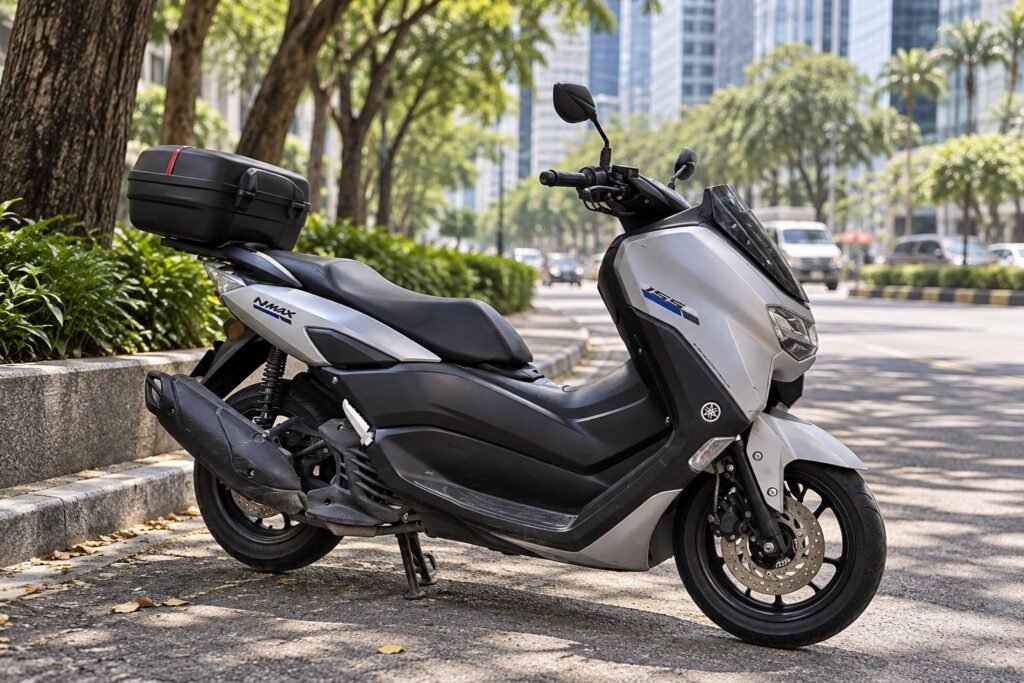
The Yamaha NMAX costs ₱155,900 and the Aerox ₱125,900 in the Philippines, and the ₱30,000 between them buys comfort, not speed. Both use the same 155cc VVA engine with nearly identical power and torque, and they weigh about the same. The NMAX gives you a lower 770 mm seat, a 7.1-liter tank against the Aerox’s 5.5 and a softer, more upright ride for distance and passengers. The Aerox gives you sharper steering, firmer suspension, more ground clearance and the lower price. Step up a trim and the gap narrows to ₱12,000: Tech MAX ₱175,900, Aerox SP ₱163,900. Renting each for a day costs ₱950 for the NMAX and from ₱750 for the Aerox, which is the cheapest way to find out which one you are before you commit.
NMAX vs Aerox price in the Philippines (2026)
| Yamaha NMAX | Yamaha Aerox | |
|---|---|---|
| Base variant | Standard — ₱155,900 | Standard — ₱125,900 |
| Top variant | Tech MAX — ₱175,900 | SP — ₱163,900 |
| Step up costs | ₱20,000 | ₱38,000 |
| Top variant adds | Y-ECVT, dual-channel ABS, traction control, new instrument cluster | Y-ECVT, single-channel ABS, traction control, 4.2-inch TFT, ride modes |
| Rent2Ride daily rate | ₱950 | ₱750 (Aerox 155) · ₱850 (Aerox V2) |
The NMAX prices are the ones Yamaha announced at the March 2025 launch of the current generation, and ZigWheels still lists the same two figures for 2026. The Aerox prices date from the all-new Aerox launch on 1 August 2025. Both are suggested retail prices; dealer promos, financing and provincial pricing will move what you actually pay.
There is no “Aerox S ABS” in the current lineup. Older listings, including our own Aerox price guide, still mention an S ABS at around ₱146,000. That was the previous generation. Since August 2025 the Aerox comes as a Standard at ₱125,900 with no ABS, or an SP at ₱163,900 with single-channel ABS. If a dealer quotes you an S ABS, you are looking at old stock.
Line the trims up properly and the decision changes shape. Standard against Standard, the NMAX costs ₱30,000 more. Top trim against top trim, it costs ₱12,000 more. And the Aerox SP, at ₱163,900, costs ₱8,000 more than a Standard NMAX, so “the Aerox is the cheap one” is only true at the bottom of the range.
Same engine, different bikes
The NMAX and the Aerox are Yamaha siblings built on the same 155cc liquid-cooled Blue Core engine with Variable Valve Actuation. VVA switches the valve timing as the revs rise, so both pull cleanly from low speed in traffic and still have something left on an open road. Claimed output is about 15 hp and 14.2 Nm for both. Neither is quicker than the other in any way you will feel on Philippine roads.
What separates them is everything around that engine. The NMAX is a maxi-scooter: lower seat, upright position, flat floorboard, softer suspension, bigger tank. The Aerox is a sport scooter with a step-through tunnel, firmer suspension, sharper steering geometry and a more forward-leaning riding position.
NMAX vs Aerox specifications
| Yamaha NMAX | Yamaha Aerox | |
|---|---|---|
| Engine | 155cc single, liquid-cooled, VVA | 155cc single, liquid-cooled, VVA |
| Power / torque | About 15 hp · 14.2 Nm | 15.1 hp · 14.2 Nm |
| Transmission | CVT; Y-ECVT on Tech MAX | CVT; Y-ECVT on SP |
| Seat height | 770 mm | 790 mm* |
| Curb weight | 131 kg | 130 kg* |
| Fuel tank | 7.1 liters | 5.5 liters |
| Underseat storage | About 25 liters | 24.5 liters |
| Ground clearance | 125 mm | 145 mm |
| ABS | Dual-channel on Tech MAX; confirm on Standard | Single-channel on SP only; none on Standard |
| Expressway-legal | No (155cc) | No (155cc) |
| Rent2Ride daily rate | ₱950 | From ₱750 |
*Yamaha Philippines did not publish seat height or weight for the 2025 Aerox at launch. The 790 mm and 130 kg figures are the ones Philippine listings carry and the ones in our Aerox guide; some overseas spec sheets quote 126 kg. The NMAX weight is also quoted as 135 kg in some places. We use 131 kg, from the dedicated specification listing, for the reasons set out in our NMAX price guide.
Three rows in that table matter more than the rest. The tank: 7.1 liters against 5.5 is about 29% more range, which on a provincial ride is the difference between one fuel stop and two. The seat: 20 mm sounds trivial until you are holding a loaded scooter on a cambered road at a stoplight. And the ground clearance, which runs the other way: the Aerox sits 20 mm higher off the road, which helps on flood-prone side streets. Storage, often assumed to be an NMAX advantage, is a wash at roughly 25 liters each.
Comfort vs sportiness: how they actually differ
The NMAX is tuned to absorb the road. The suspension soaks up patched tarmac and expansion joints rather than fighting body roll, the seat is broad enough for a long stint, and the riding position is upright with room to move your feet on the floorboard. At open-road speed it feels planted. The trade is eagerness: it does not change direction with the Aerox’s immediacy, and it is not the bike for darting through gaps on EDSA.
The Aerox is the opposite trade. Steering is quicker, damping is firmer and the whole machine feels more connected to the surface. On smooth roads that is genuinely enjoyable. On broken ones the firm setup transmits everything, and over a long day on rough roads it is the more tiring bike, more so for a passenger. The forward-leaning position suits taller riders and the sporty intent, but puts more weight on your wrists in stop-start traffic.
The 2025 generation added Yamaha’s Y-ECVT on the top trims of both. It is an electronically controlled CVT with Sport and Touring modes and a three-level downshift control that lets you drop the ratio on demand for overtaking or engine braking. It is only on the ₱175,900 Tech MAX and the ₱163,900 SP, not on either Standard.
ABS: the variant question that matters most
On wet Philippine roads (painted markings, steel plates, diesel-slicked junctions) a locked front wheel is how a small moment becomes a crash. ABS is the one safety feature you cannot sensibly retrofit, so it should weigh more in this decision than styling or a screen.
The Aerox makes it simple: the Standard has no ABS, and the SP has single-channel ABS working on the front wheel. The NMAX Tech MAX has dual-channel ABS, front and rear, plus traction control. The NMAX Standard is the unclear one: Yamaha’s launch coverage describes it as the version without Y-ECVT and the new instrument cluster, but does not spell out its brakes. Ask the dealer directly and check the spec sheet on the bike in front of you before you sign.
If ABS is a must and the budget is fixed, the cheapest confirmed ABS option of the four is the Aerox SP at ₱163,900, and the most complete one is the NMAX Tech MAX at ₱175,900.
Who each one suits
Buy the NMAX if you ride distance, carry a passenger regularly, have a long daily commute or are shorter and want the lower seat. It is the more relaxed bike and the one that leaves you less tired after two hours. It suits you less if your streets flood (125 mm is the lowest clearance of the popular 155cc–160cc scooters we cover) or if your riding is short city hops, where you are paying for comfort you will not use.
Buy the Aerox if you ride mostly in the city, value quick steering over plush suspension, are tall enough to be comfortable on a 790 mm seat and want to keep ₱30,000 in your pocket. It suits you less if you are around 5′4″ or shorter, ride two-up most days or face long stretches of broken road.
If storage is what you are really shopping for, neither is the answer: the Honda PCX 160 has about 30 liters under the seat. Our PCX 160 guide covers it, and our ADV 160 vs PCX 160 comparison does the same job for Honda’s pair.
The verdict
Choose by journey, not by badge. For distance, a passenger or comfort over a long commute, the NMAX is the better scooter and worth the ₱30,000. For city riding, spirited handling or a tighter budget, the Aerox is the better buy. If you want ABS, compare the Aerox SP against the NMAX Tech MAX rather than the Standards. At that level the gap is ₱12,000 and both have the Y-ECVT.
Neither bike is allowed on tolled expressways. DOTC Department Order 2007-38 sets a 400cc minimum for motorcycles on expressways, and at 155cc both are far below it. If NLEX or SLEX is part of the plan, our guide to motorcycle expressway rules explains what qualifies.
Running costs
With a shared engine, running costs are close. Budget for annual LTO registration, insurance beyond the TPL minimum, oil changes and CVT belt and roller service, the item owners most often put off until the transmission slips. We do not print fuel-economy figures: Yamaha Philippines publishes none for either 2025-generation bike, and owner-reported numbers vary too widely. The NMAX’s bigger tank means fewer stops, not cheaper ones.
Rent both before you commit
A showroom sit tells you whether your feet reach the ground. It does not tell you whether the Aerox’s firm ride wears thin after an hour on C5, or whether the NMAX feels too soft. A day on each does, for a small fraction of the price gap.
Rent2Ride Manila rents the Yamaha NMAX 155 V2 for ₱950 a day (fitted with a lockable top box), the Yamaha Aerox 155 for ₱750 a day and the Yamaha Aerox V2 for ₱850 a day. One day on each costs ₱1,700. Every rental includes one helmet, a phone holder, 250 km of mileage per day and TPL insurance, with same-to-same fuel. The refundable deposit is ₱3,000 for all three bikes, within our general ₱2,000–₱5,000 range.
Be clear about what you are testing. Our units are previous-generation bikes, in the fleet before the current NMAX and Aerox launched, so they do not have the Y-ECVT. They will tell you which riding position, seat and suspension character suits you. They will not tell you what the electronic transmission adds.
We are open daily from 6:00 AM to 11:00 PM at Stall No. 9, Washington Street corner Urban Avenue, Makati, and on WhatsApp at +63 960 245 4398. You need a valid driver’s license that covers motorcycles and two government-issued IDs to surrender at pickup. Under RA 4136, visiting riders can use a home-country license for up to 90 days from arrival; if it is in English, an International Driving Permit is not legally required. Our IDP guide has the detail, and the full terms are on the rental requirements page. The full fleet page shows what is free on your dates.
Frequently asked questions
Which is better, the NMAX or the Aerox?
Neither is better outright. The NMAX is the comfort bike: lower 770 mm seat, 7.1-liter tank, softer suspension, better two-up. The Aerox is the sport bike: quicker steering, firmer ride, more ground clearance, ₱30,000 cheaper at the Standard trim. Long rides and passengers favor the NMAX; city riding and budget favor the Aerox.
How much are the NMAX and Aerox in the Philippines in 2026?
NMAX Standard ₱155,900 and Tech MAX ₱175,900. Aerox Standard ₱125,900 and Aerox SP ₱163,900. These are suggested retail prices from the 2025 launches of the current generations; dealer promos and financing change what you pay.
Does the Aerox have ABS?
Only the Aerox SP, at ₱163,900, which has single-channel ABS on the front wheel. The ₱125,900 Standard has no ABS. The “S ABS” variant listed at around ₱146,000 on older pages belongs to the previous generation.
Can the NMAX or Aerox go on the expressway?
No. Both are 155cc, and DOTC Department Order 2007-38 sets a 400cc minimum for motorcycles on tolled expressways. The Toll Regulatory Board applies that figure exactly, so no scooter in this class qualifies.
Can I rent an NMAX and an Aerox in Manila to compare?
Yes. Rent2Ride Manila in Makati rents the NMAX 155 V2 at ₱950 a day and the Aerox at ₱750 (Aerox 155) or ₱850 (Aerox V2), each with one helmet, a phone holder, 250 km of daily mileage and TPL insurance. Our units are previous-generation bikes without the Y-ECVT.
Sources
NMAX prices, Tech MAX equipment and underseat storage from Top Gear Philippines, 15 March 2025, cross-checked against ZigWheels Philippines. Aerox prices and variant equipment from Top Gear Philippines, 4 August 2025, and Inside Racing, 1 August 2025. Aerox engine output, ground clearance, tank and storage from ZigWheels Philippines’ launch report, 1 August 2025. NMAX seat height, weight, tank and ground clearance, and Aerox seat height and weight, as verified in our NMAX and Aerox guides. Expressway displacement rule from Top Gear Philippines’ report on the TRB directive, 18 August 2018. All verified 27 October 2026. Rental rates, deposits and inclusions from our own live pricing on the same date.