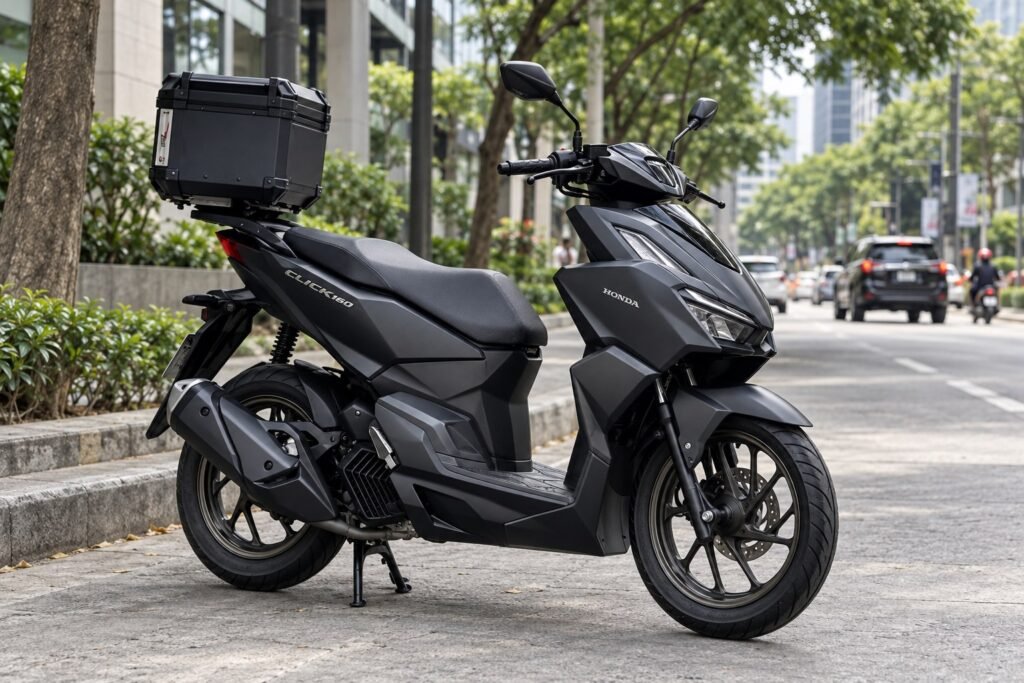
Riding a motorcycle in Manila is reasonably safe for a licensed, experienced rider who rides defensively, and genuinely risky for anyone still learning. The numbers are sobering: the MMDA counted 31,186 motorcycle-related crashes in Metro Manila in 2023, more than a third of the 85,954 crashes it recorded, and in 2024 collisions between trucks and motorcycles killed more people than any other crash type. Most of that risk comes from a few predictable things: big vehicles, sudden stops, night riding, bad surfaces and floods. Learn to read them and Manila is manageable. Do not learn to ride here. If you can already ride, scooters rent from ₱525 a day, so you can try the city before you commit.
Manila motorcycle safety by the numbers
| All road crashes, Metro Manila, 2023 | 85,954 (MMDA) |
|---|---|
| Motorcycle-related crashes, Metro Manila, 2023 | 31,186, up about 17% from 26,599 in 2022 (MMDA) |
| Deadliest collision types, Metro Manila, 2024 | Truck vs motorcycle: 62 killed · Car vs motorcycle: 55 · Motorcycle vs pedestrian: 36 · Motorcycle vs motorcycle: 33 (MMDA) |
| When fatal crashes happen | Mostly between 6 p.m. and 6 a.m. (MMDA, 2013–2023) |
| Land transport deaths, Philippines, 2023 | 13,125, the highest in over a decade (PSA) |
| Police-recorded crashes, Philippines, 2024 | About 31,000 crashes and 2,747 deaths; over 15,000 of the 47,206 vehicles involved were motorcycles (PNP Highway Patrol Group) |
| Holiday period nationwide, 21 Dec 2025–2 Jan 2026 | 1,113 road crash injuries; 6 of 7 deaths involved motorcycles; about 87% of the injured wore no helmet or seatbelt (DOH) |
A few honest caveats. The 2023 figures are the latest full-year motorcycle breakdown we could open from the MMDA’s accident reporting system, MMARAS. The 2024 MMDA figures we found cover crash types, not a motorcycle total. Reports of how many motorcyclists died in Metro Manila in 2023 disagree with each other, so we do not print a number.
The two national death tolls also look contradictory and are not. The PSA counts registered deaths from all land transport accidents nationwide. The police count only the crashes they recorded. Neither is wrong; they measure different things. Both say the same thing about motorcycles: they are the vehicle most often involved.
The numbers do not say riding here is reckless. They say Manila punishes mistakes, and that the mistakes follow a pattern.
What makes Manila riding risky
Buses and trucks
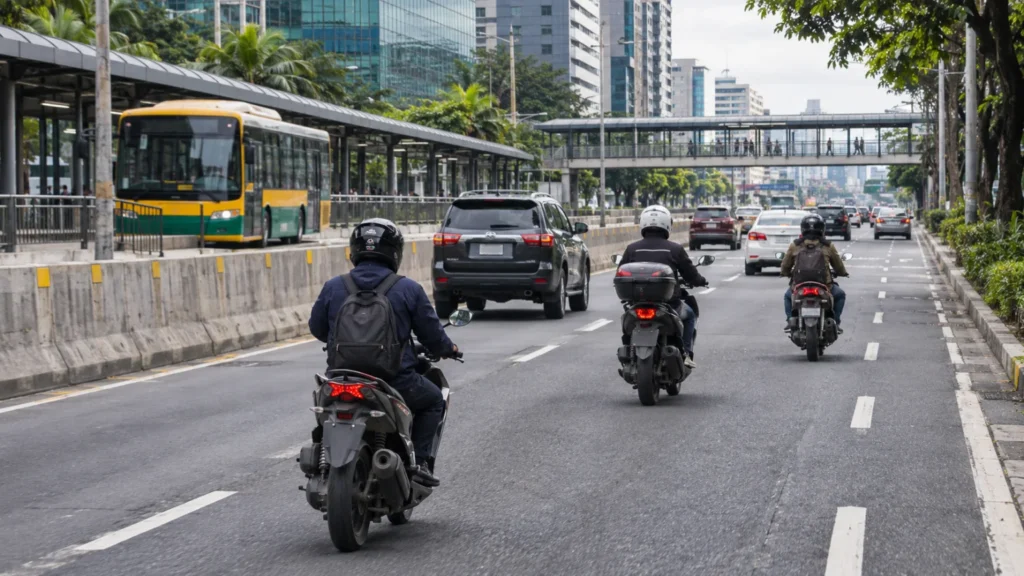
The single deadliest collision type in Metro Manila in 2024 was a truck hitting a motorcycle. Buses and trucks change lanes with little warning, swing wide on turns and cannot see a scooter tucked beside their rear wheels. Never ride alongside a bus or truck longer than you must, never squeeze between one and the curb, and assume the driver has not seen you.
Jeepneys, tricycles and sudden stops
Jeepneys stop wherever a passenger wants to get on or off, often with no signal, and often by cutting straight across to the curb. Tricycles and pedicabs pull out from side streets at walking pace. The rider who gets hurt is usually the one filling the gap on the jeepney’s right side when it stops. Watch passengers, not just the vehicle: a raised hand on the sidewalk means the jeepney ahead is about to brake.
Night riding
Most fatal crashes in Metro Manila happen between 6 p.m. and 6 a.m. Visibility falls, many side streets are poorly lit, and potholes vanish into the dark. If you are new to the city, ride your first days in daylight.
Road surfaces
Potholes, uneven patches, open drains, steel plates over roadworks and raised manhole covers are everywhere, and they are hardest to see in the rain or at night. A pothole that a car absorbs can throw a scooter’s small front wheel. Keep enough distance to see the road surface ahead, not just the bumper.
Rain and flooding
The first rain makes roads slick, painted lines turn to ice, and floodwater hides open manholes. A scooter is the first vehicle a flood stops. Our guide to riding in the rain explains what PAGASA’s warnings and the MMDA’s flood levels mean on two wheels.
Defensive riding habits for Manila traffic
- Ride as if invisible. Assume no one has seen you until they make eye contact, and even then, keep a way out.
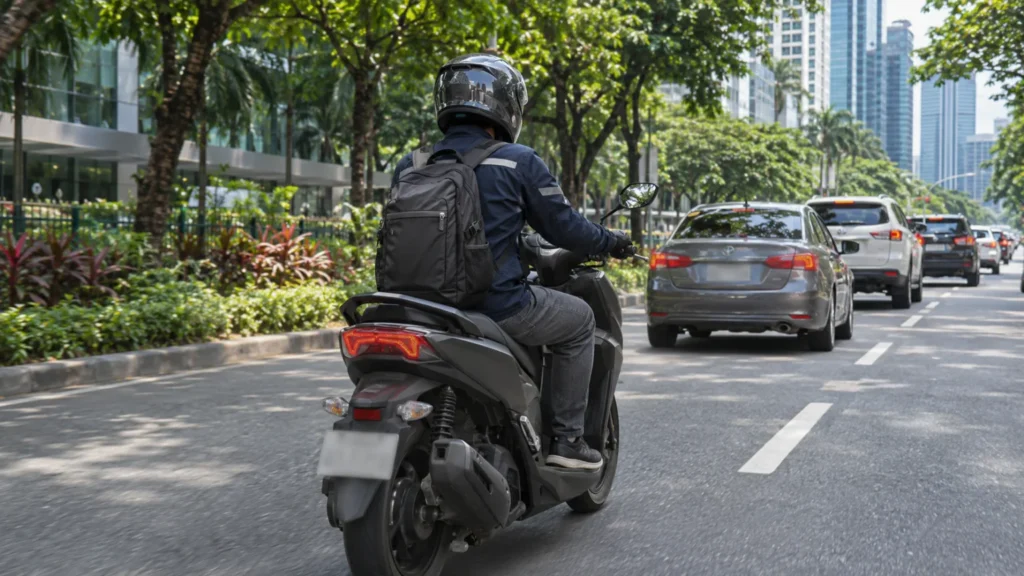
- Own your lane position. Ride where mirrors can see you, not in blind spots. Leave space on the side the jeepney or bus will swerve into.
- Cover your brakes near intersections, bus stops, jeepney loading points and mall entrances.
- Do not trust the green light. Look both ways before entering an intersection; someone will be running the red.
- Keep your speed down when filtering. The gap between slow cars can close in an instant when a door opens or a car changes lanes.
- Use your horn early and lightly. In Manila it means “I am here”, not anger.
- Plan the route, not just the destination. Main roads are busier but better lit and better surfaced than shortcuts.
- Know where you cannot go. Motorcycles under 400cc are barred from tolled expressways such as Skyway, NLEX and SLEX. Our expressway rules guide explains the 400cc line.
- Ride sober and rested. No exceptions.
The gear to wear
Republic Act 10054 requires every rider and back rider to wear a standard motorcycle helmet bearing the Philippine Standard (PS) or Import Commodity Clearance (ICC) mark. Every Rent2Ride rental comes with one helmet, and a second is an add-on. Beyond the legal minimum:
- Full-face helmet if you have one: it protects your jaw and keeps out rain, dust and insects.
- Closed shoes, never slippers. Your feet are the first thing to touch the road in a fall.
- Gloves: your hands go down first.
- A jacket with long sleeves, even in the heat. A light mesh riding jacket is far better than skin on asphalt.
- Something bright or reflective for night and rain.
- Rain gear in the wet months; a rain poncho can be added to any rental.
Who should, and should not, ride in Manila
Ride here if you hold a license that covers motorcycles, you have real riding experience, you are comfortable in heavy traffic, and you are willing to ride defensively rather than fast. Visitors can use a home-country license for up to 90 days from arrival; our guides to riding in the Philippines as a foreigner and the international driving permit cover the rules.
Do not ride here if you have never ridden before, or only ridden a few times. EDSA at rush hour is not a training ground. Your first hours on a motorcycle should be in an empty lot or with an instructor, not between a bus and a jeepney. In Metro Manila, the MMDA runs a free Motorcycle Riding Academy in Pasig, which the LTO set out to accredit as a practical driving exam center; check with the MMDA for current schedules. Our beginner’s guide explains the licensing path.
Think twice if you have only ridden on quiet roads at home, you are tired from a long flight, or you plan to ride at night in the first days. Start with a daytime ride on a light automatic and build up.
Manual bikes need more of you in traffic. If you have not ridden a clutch in stop-and-go conditions, start on a scooter. Our scooter vs motorcycle guide explains why.
If something goes wrong
Save two numbers before you ride. 911 is the government’s unified emergency hotline; call it first if anyone is hurt. (02) 136 is the MMDA’s Metrobase line for minor road crashes and other traffic incidents in Metro Manila; when it was relaunched in February 2026, the MMDA said a human operator would answer within five minutes.
Move yourself and the bike out of traffic only if it is safe and no one is injured, and take photos of the scene, the vehicles and plate numbers. If you are on a rental, call or message the shop as soon as you are safe. For Rent2Ride that is +63 960 245 4398, and we will tell you what to do next. Every rental carries basic TPL insurance, and optional fuller coverage can be added at booking; ask us what it covers before you ride.
Start easy: renting in Makati
If you can already ride, the best way to find out whether Manila riding is for you is to do it on a light automatic before committing to anything. A Honda Click 125 rents from ₱525 a day and is the easiest bike in our fleet to handle in traffic. The Yamaha NMAX 155 V2 (₱950) is calmer two-up, and the Honda ADV 160 (₱1,200) has the most ground clearance of our scooters for rough roads. The full fleet page shows every bike and its current rate.
Every rental includes one helmet, a phone holder, 250 km of mileage a day and TPL insurance, with optional extra coverage. The refundable deposit is ₱2,000 for scooters, ₱4,000 for the WR155 and ₱5,000 for the big bikes. You need a valid license that covers motorcycles, and the manual bikes also need genuine clutch experience. We are open daily from 6:00 AM to 11:00 PM at Stall No. 9, Washington Street corner Urban Avenue, Makati. The rental requirements page has the full list, and the contact page is the place to ask about routes before you ride.
Frequently asked questions
Is it safe to ride a motorcycle in Manila?
For a licensed, experienced rider who rides defensively, yes, reasonably. Motorcycles are involved in a large share of crashes: the MMDA counted 31,186 motorcycle-related crashes in Metro Manila in 2023 out of 85,954. Most of the risk comes from large vehicles, sudden stops, night riding, poor surfaces and floods.
Can a beginner learn to ride in Manila?
Not in traffic. Learn in an empty lot or with a riding school first. The MMDA runs a free Motorcycle Riding Academy in Pasig. Ride Metro Manila’s main roads only once you can brake, turn and stop without thinking about it.
What is the most dangerous time to ride in Metro Manila?
At night. MMDA data for 2013–2023 shows most fatal road crashes happened between 6 p.m. and 6 a.m., while most non-fatal crashes happened in the daytime.
What helmet do I need in the Philippines?
RA 10054 requires both the rider and any passenger to wear a standard motorcycle helmet bearing the PS or ICC mark. Rent2Ride includes one helmet with every rental, and a second is available as an add-on.
Can tourists ride motorcycles in Manila?
Yes, with a license that covers motorcycles. A foreign license is valid for up to 90 days from arrival. Motorcycles under 400cc cannot use tolled expressways, and that includes every scooter.
Sources
Metro Manila crash totals, 2024 collision types and crash timing from MMDA data reported by the Philippine Daily Inquirer, 27 June 2025, and GMA News, 26 June 2025. 2022–2023 motorcycle crash counts from the MMDA Road Safety Unit via Technobaboy, 9 April 2024. PSA land transport deaths from BusinessWorld, 21 May 2025. Police crash data from Carmudi, 3 February 2025. Hotlines from DILG CALABARZON, 16 March 2026, and The Philippine Star, 27 February 2026. Holiday injury data from the DOH via the Daily Tribune, 3 January 2026. Road safety targets from WHO Philippines. MMDA Motorcycle Riding Academy from GMA News, 6 June 2024. Helmet requirement from Republic Act No. 10054. All verified 30 October 2026. Rental rates and terms from our own live site on the same date.