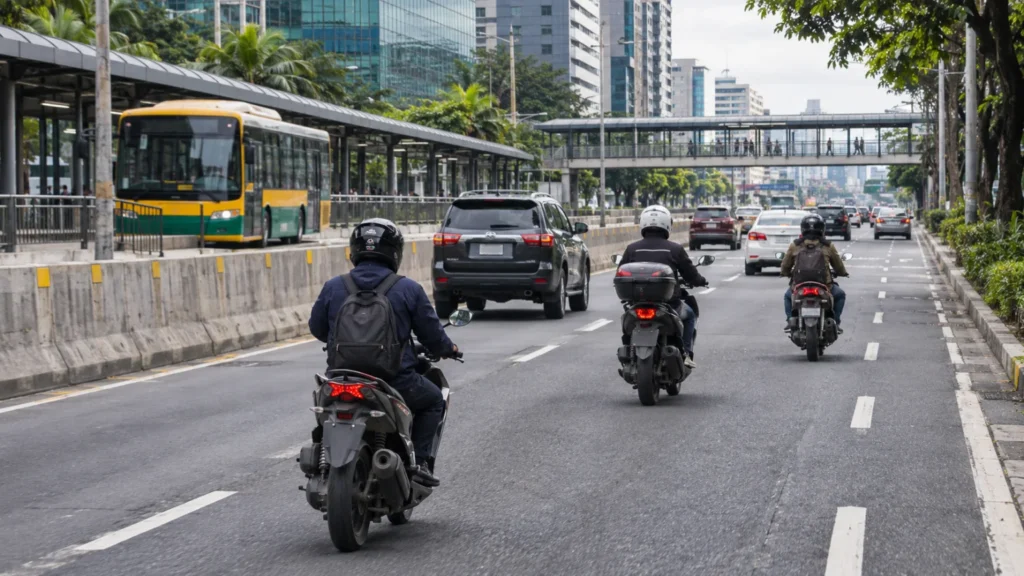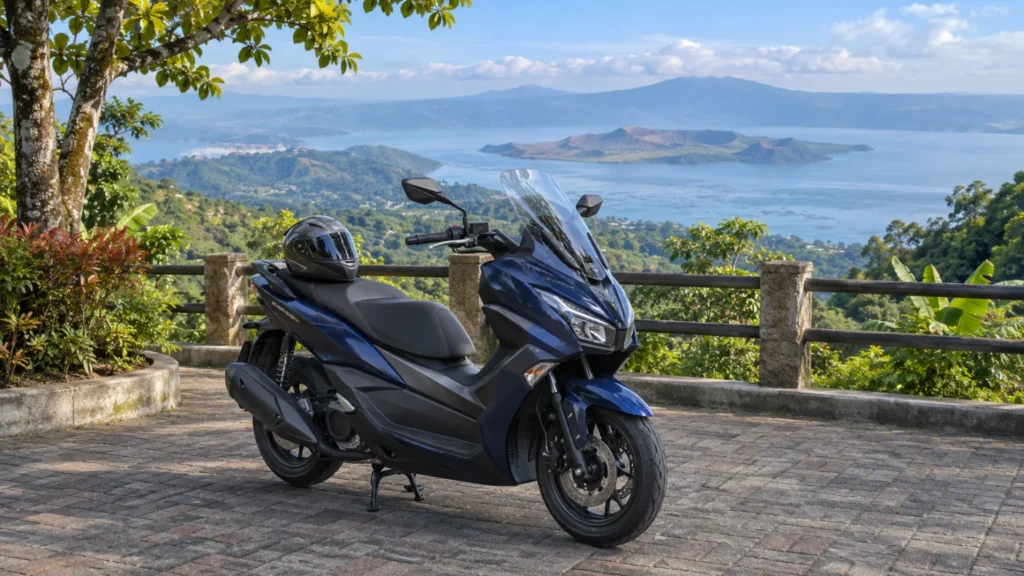
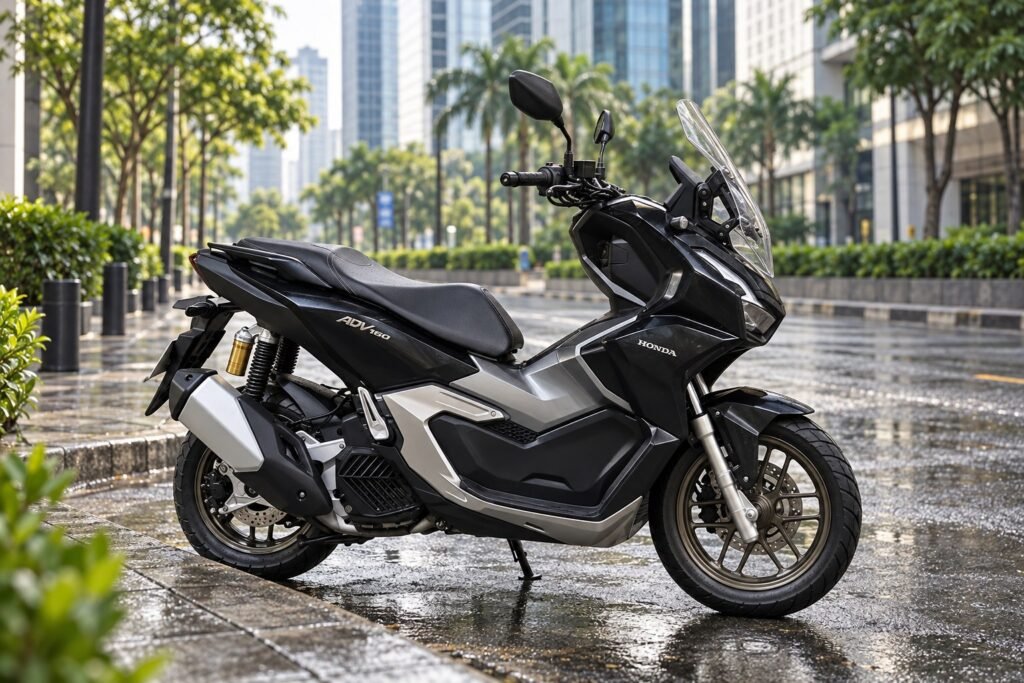
You can ride a motorcycle in the rain in the Philippines, but you should never ride into floodwater, and you should stay off the bike once PAGASA raises an orange or red rainfall warning or any tropical cyclone wind signal over where you are riding. Light rain mostly means longer braking distances, smoother inputs and making sure you are seen. Floods are different: the MMDA’s lowest flood level is already deeper than the ground clearance of any scooter we rent, and floodwater carries leptospirosis. Below is what each warning and signal means on two wheels, how to read MMDA flood reports, and what to do if a bike gets caught. A rain poncho is an add-on with every rental, and the high-riding Honda ADV 160 rents for ₱1,200 a day.
Rain and typhoon riding at a glance
| What PAGASA or MMDA says | What it means | Our advice on a motorcycle |
|---|---|---|
| Light rain, no warning | Wet roads, reduced grip and visibility | Ride, slower, with longer gaps |
| Yellow rainfall warning | 7.5–15 mm of rain an hour; flooding possible in low areas | Finish your trip or wait it out; avoid low roads and underpasses |
| Orange rainfall warning | 15–30 mm an hour; flooding threatening | Do not start a ride; get somewhere dry |
| Red rainfall warning | More than 30 mm an hour; serious flooding expected | Stay off the bike |
| Wind Signal No. 1 or higher | Winds of 39 km/h and up within 36 hours | Do not plan a ride, especially on flyovers, bridges or the coast |
| MMDA: “gutter-deep” | About 8 inches (20 cm) of water | Already deeper than any scooter’s ground clearance; find another road |
| MMDA: “NPLV” or “NPATV” | Not passable to light vehicles, or to any vehicle | Not for a motorcycle, full stop |
The advice column is our judgment as a rental shop, not a PAGASA or MMDA rule. We set the line low because a motorcycle is the vehicle that fails first in water and wind.
PAGASA rainfall warnings, translated for riders
PAGASA’s heavy rainfall warnings measure rain that is already falling, per hour, for named areas. Yellow (“be alert”) is already heavy rain on a bike: visibility drops, water pools in dips and underpasses, and drivers stop seeing you. At orange (“be prepared”), roads that were dry an hour ago can go under, and you will not know which ones until you reach them. Red (“take action”) means communities are being told to act now.
Do not confuse these with PAGASA’s weather advisories, which use the same colors for the rain forecast over the next 24 hours (yellow 50–100 mm, orange 100–200 mm, red over 200 mm). Plan your day with the advisory; decide whether to ride with the warning.
Tropical cyclone wind signals and a motorcycle
Wind signals are about wind, not rain. A gust that rocks a car can push a scooter across a lane, and it hits hardest where you have nowhere to go: flyovers, bridges and open stretches like Roxas Boulevard.
| Signal | Wind speed | Lead time | PAGASA’s expected impact |
|---|---|---|---|
| No. 1 | 39–61 km/h | 36 hours | Minimal to minor damage; minimal disruption to transport |
| No. 2 | 62–88 km/h | 24 hours | Minor to moderate damage; loose objects become projectiles; some power lines down |
| No. 3 | 89–117 km/h | 18 hours | Substantial damage to light structures; wide power outages |
| No. 4 | 118–184 km/h | 12 hours | Severe damage; near-total loss of power and communications |
| No. 5 | 185 km/h or more | 12 hours | Severe to catastrophic damage |
The lead time is how far ahead the winds are expected, so Signal No. 1 can go up while it is still calm. That is the moment to make plans that do not need a motorcycle. By Signal No. 2, flying debris and fallen lines are part of the forecast, and a rider has no roof.
Floodwater: when not to ride through it
The MMDA reports flooding with a fixed gauge. Learn its terms:
| MMDA term | Depth | MMDA category |
|---|---|---|
| Gutter-deep | 8 in (about 20 cm) | PATV: passable to all types of vehicles |
| Half-knee-deep | 10 in (about 25 cm) | PATV |
| Half-tire-deep | 13 in (about 33 cm) | NPLV: not passable to light vehicles |
| Knee-deep | 19 in (about 48 cm) | NPLV |
| Tire-deep | 26 in (about 66 cm) | NPATV: not passable to any vehicle |
| Waist-deep and chest-deep | 37 and 45 in | NPATV |
“Passable to all types of vehicles” is written with cars, jeepneys and trucks in mind. Put the numbers next to a scooter: the Honda ADV 160, which has the most ground clearance of any scooter we rent, sits at 165 mm. Gutter-deep water is about 203 mm. The Yamaha WR155 dual-sport has 245 mm, far more than any scooter, and even that is below half-knee depth.
On a scooter, the engine, the CVT belt housing and the air intake all sit low. Water drawn into the intake can stall the engine or damage it internally. We do not print a “safe wading depth” for any model, because no manufacturer we checked publishes one for these bikes, and you cannot see what the water hides anyway: an open manhole, a missing drain grate, a pothole.
Our rule: if you cannot see the road surface under the water, do not ride through it. Wait, turn around, or park on high ground and let it drain.
Braking and traction on wet roads
- The first rain is the slipperiest. Oil and rubber on dry roads float up when rain starts. Ride most gently early in a downpour.
- Use both brakes, earlier and more gently. Squeeze progressively and leave at least twice your usual gap.
- Avoid the shiny stuff. Painted lines, steel plates over roadworks, manhole covers and flyover joints are far slicker wet than asphalt. Cross them upright, not braking or leaning.
- Be smooth. Most wet-road falls come from a sudden input, not the rain itself.
- Puddles hide holes. Treat standing water as a pothole until proven otherwise.
Visibility: being seen and seeing
In heavy rain, drivers’ windows fog and their mirrors fill with droplets, and a dark-clad rider disappears. Keep your headlight on, wear something bright or reflective over your rain gear, stay out of blind spots beside buses and trucks, and make every lane change slow and obvious. Use a clear visor, crack it open a notch if it fogs, and ride before dark when you can: rain at night scatters headlights across your visor and hides potholes.
Raincoats and gear
- A two-piece rain suit beats a poncho. Jacket and trousers stay put at speed; a poncho can billow, so tuck it in and keep it clear of the rear wheel. A rain poncho can be added to any rental at booking.
- A proper helmet. RA 10054 requires rider and passenger to wear a standard helmet bearing the PS or ICC mark. A clear full-face visor keeps rain out of your eyes.
- Closed shoes and gloves. Wet sandals slip off floorboards, and gloves keep your grip consistent.
- A zip bag for your license, the bike’s documents and your phone.
Leptospirosis: the risk after the ride
Floodwater contaminated by rat urine spreads leptospirosis, and the Department of Health recorded 5,486 cases nationwide from January to 26 August 2026. In August, DOH Undersecretary Gloria Balboa told anyone who had waded through floodwater to go to the nearest health center, with or without a wound and with or without symptoms. The DOH ranks wading without cuts as low risk, with an open wound as moderate, and repeated wading as high.
Pushing a stalled bike through a flood counts as wading. Wash exposed skin with soap and clean water and see a health center the same day. Preventive medicine is a prescription drug, so let the health center decide whether you need it.
Where Metro Manila floods
We do not reprint a “flood-prone areas” list: the MMDA revises its own, and the copies circulating online are years old. Here is a dated example instead. During the habagat rains on 8 August 2026, the MMDA reported, among others:
- G. Araneta Avenue in Quezon City at tire-deep, not passable to any vehicle
- Zapote Junction in Las Piñas at knee-deep, not passable to light vehicles
- MacArthur Highway in Dalandanan, Valenzuela, and the Ninoy Aquino Oyster Plaza area in Parañaque at half-tire-deep, not passable to light vehicles
- EDSA in front of SM North and the Roxas Boulevard–Pedro Gil service road at gutter-deep
No Makati street was on that night’s list, which says nothing about the next storm. In heavy rain, check the MMDA’s live flood updates on its official accounts before you leave.
The rest of 2026
PAGASA declared the end of the habagat (southwest monsoon) season on 5 October 2026 and the start of the amihan (northeast monsoon) on 27 October. That does not mean dry roads. In its 22 October briefing, PAGASA said it expects one or two tropical cyclones in each of November and December, even as it forecast below-normal rainfall over most of the country in November under a strong El Niño. Check the forecast the day before a long ride, and again that morning.
If your rental bike gets caught in a flood
If the bike stalls in water, do not try to restart it; cranking an engine that may have water inside can turn a drying-out job into a rebuild. Switch off, push it to higher ground if that is safe, and get yourself out of the water.
Then call or message us at +63 960 245 4398 before doing anything else to the bike. Tell us where you are, take photos if you can, and we will tell you what to do next. Our site does not publish a flood-damage policy, so we will not guess at one. It does say the security deposit is refunded on return as long as there is no damage, that every bike carries basic TPL insurance, and that optional full coverage can be bought at booking. Riding through the wet months? Ask about that coverage when you reserve.
Renting for the wet season
No bike makes flooding safe, but some make wet roads easier. The Honda ADV 160 (₱1,200 a day) has the most ground clearance of our scooters and longer suspension travel than a city scooter. The Yamaha NMAX 155 V2 (₱950) is a stable, comfortable choice two-up. Riders who know a clutch can take the Yamaha WR155 (₱1,200) over broken, puddled roads. Our scooter vs motorcycle guide covers the trade-offs, and the beginner’s guide explains why new riders should start on an automatic.
Scooters start at ₱525 a day for a Click 125; the full fleet page shows current rates. Every rental includes one helmet, a phone holder, 250 km a day and TPL insurance. The refundable deposit is ₱2,000 for scooters, ₱4,000 for the WR155 and ₱5,000 for the big bikes, and you need a valid license that covers motorcycles. We are open daily, 6:00 AM to 11:00 PM, at Stall No. 9, Washington Street corner Urban Avenue, Makati. See the rental requirements page or our requirements guide, and use the contact page if the forecast changes your plans.
Frequently asked questions
Is it safe to ride a motorcycle in the rain?
In light to moderate rain, yes, if you slow down, brake earlier and more gently, avoid painted lines and metal plates, and make sure you can be seen. It is not safe to ride into floodwater, in a PAGASA orange or red rainfall warning area, or under a tropical cyclone wind signal.
What do PAGASA’s yellow, orange and red rainfall warnings mean?
They measure rain already falling. Yellow is 7.5–15 mm an hour, with flooding possible in low-lying areas. Orange is 15–30 mm an hour, with flooding threatening. Red is more than 30 mm an hour, with severe flooding expected. PAGASA’s weather advisories use the same colors for forecast 24-hour rainfall.
Can a scooter go through a flood?
Do not try. The MMDA’s lowest flood level, gutter-deep at about 8 inches, is deeper than the ground clearance of any scooter we rent. Water drawn into the low air intake can stall or damage the engine, and floodwater hides open drains.
Should I ride during Signal No. 1?
We advise against it. Signal No. 1 means winds of 39–61 km/h are expected within 36 hours, and gusts hit motorcycles hardest on flyovers and bridges.
What should I do if my rental motorcycle stalls in floodwater?
Do not restart it. Switch it off, move it to higher ground if that is safe, get out of the water, and contact the rental shop. For Rent2Ride, call or message +63 960 245 4398 and take photos. See a health center the same day if you waded through floodwater.
Sources
Tropical cyclone wind signal speeds, lead times and impacts from PAGASA. Rainfall warning levels from PAGASA’s warning legend, with hourly and 24-hour thresholds from The Varsitarian’s explainer, 24 July 2025. MMDA flood gauge from Interaksyon, 4 September 2024. Flooded areas of 8 August 2026 from the MMDA via GMA News. Leptospirosis guidance and case count from the DOH via GMA News, 28 August 2026. Season dates from GMA News, 5 October 2026, and the Daily Tribune, 27 October 2026; November–December outlook from PAGASA via GMA News, 22 October 2026. Helmet requirement from Republic Act No. 10054. Ground clearance figures as verified in our guides to each model. All verified 30 October 2026. Rental rates, add-ons and deposit terms from our own live site on the same date.