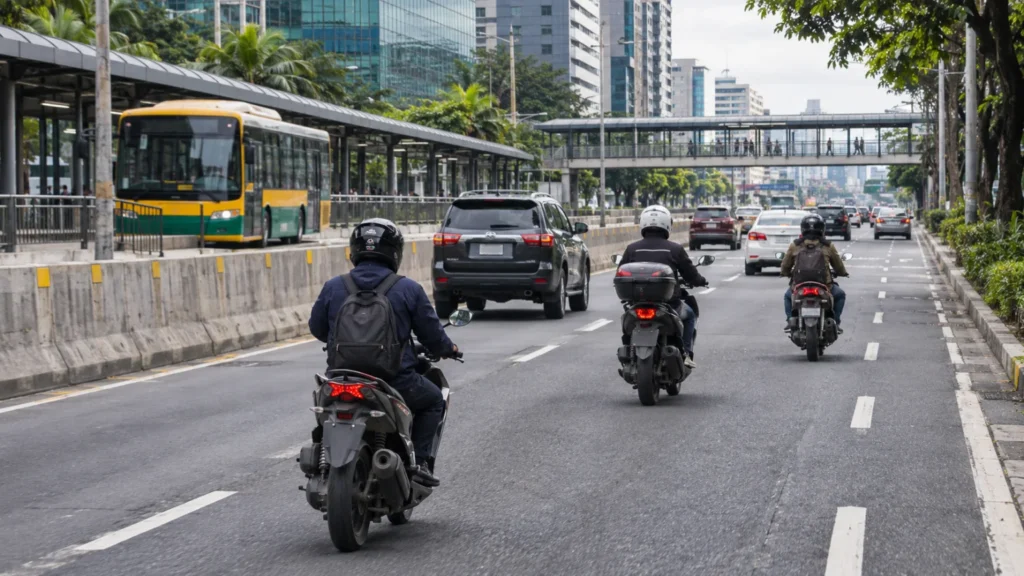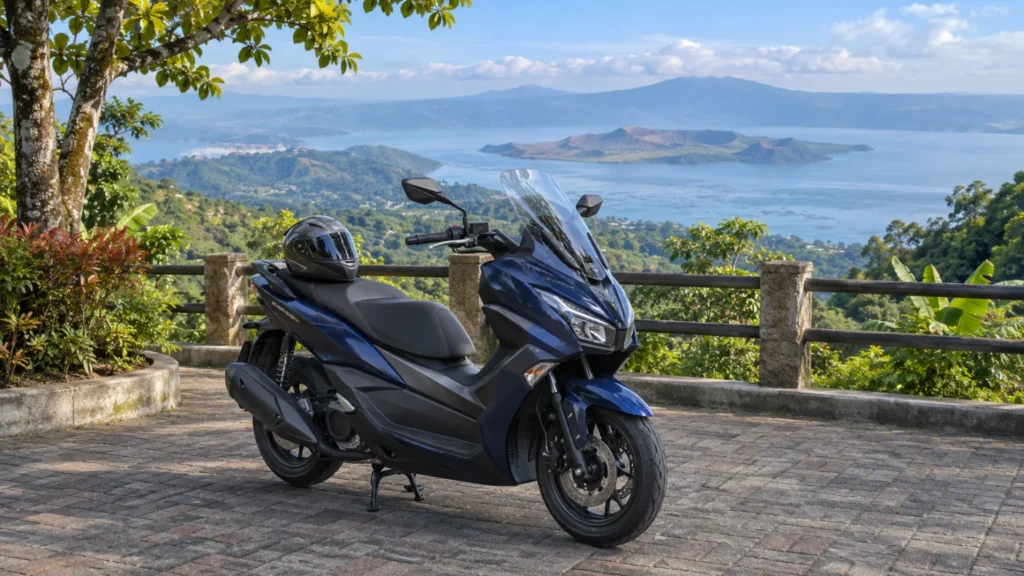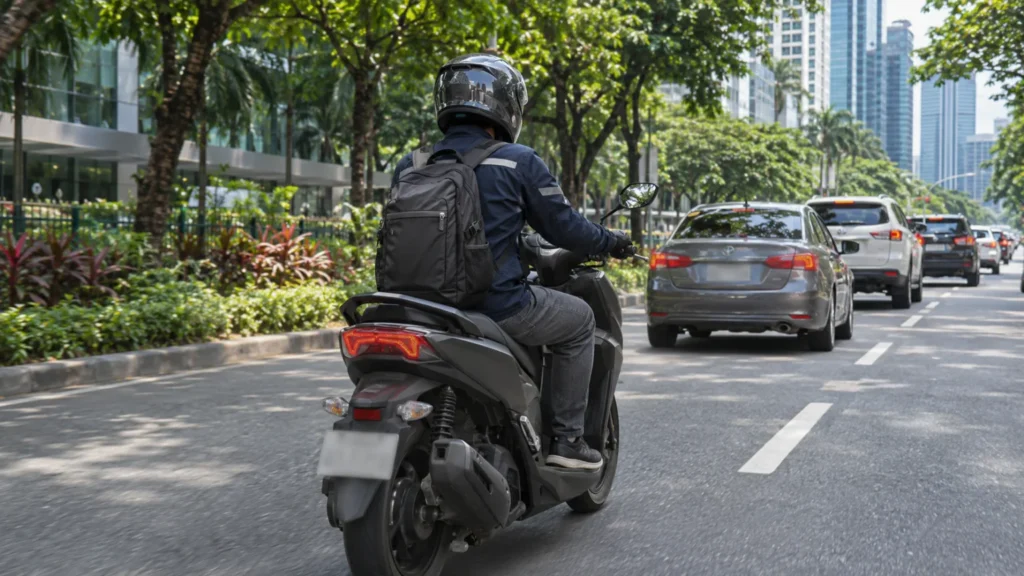
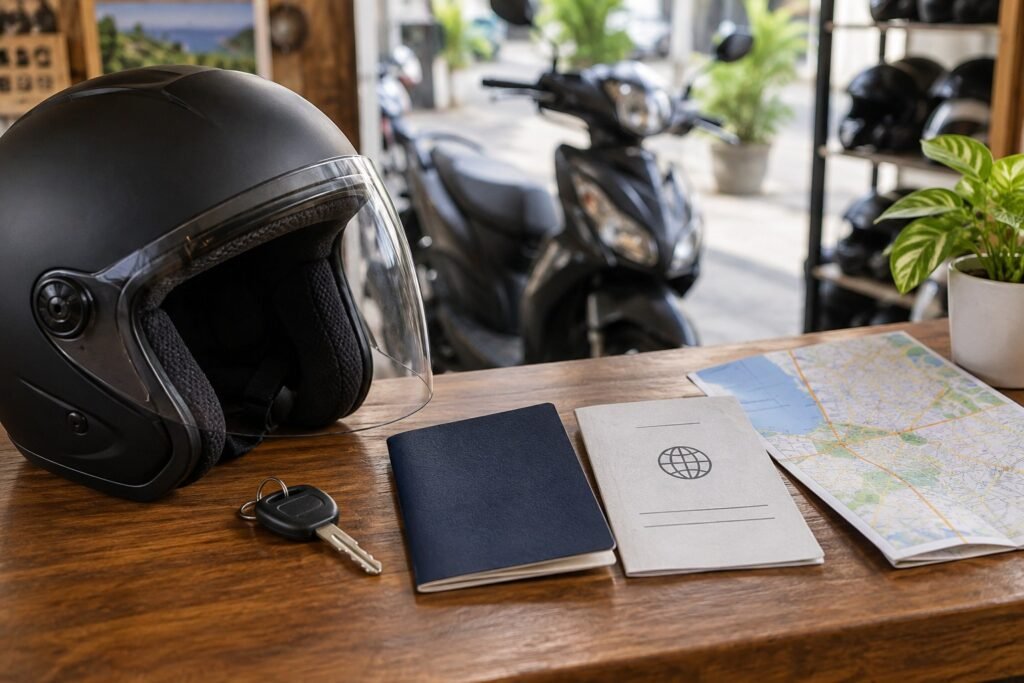
Every motorcycle rider and back rider in the Philippines must wear a standard protective helmet on every road, and the fine for not wearing one is ₱1,500 for a first offense, rising to ₱10,000 plus confiscation of the driver’s license by the fourth. That is Republic Act No. 10054, the Motorcycle Helmet Act of 2009. A “standard” helmet is one that meets the Department of Trade and Industry’s specifications and carries a Philippine Standard (PS) mark or an Import Commodity Clearance (ICC) sticker. A helmet with a fake sticker is treated as no helmet at all. A child may ride pillion only if they reach the foot pegs, can hold the rider’s waist and wear a proper helmet. Every Rent2Ride Manila rental, from ₱525 a day, includes one helmet, so you can ride legally before you commit to buying gear.
The helmet law at a glance
| Law | RA 10054, the Motorcycle Helmet Act of 2009, approved March 2010 |
|---|---|
| Rules | DOTC-DTI Joint Administrative Order No. 2011-01 |
| Who must wear one | All riders, drivers and back riders, on any road, short trip or long |
| Exempt | Tricycle drivers |
| What counts | A helmet meeting DTI specifications with a PS mark or ICC sticker |
| Fine, no helmet | ₱1,500, then ₱3,000, ₱5,000 and ₱10,000 plus license confiscation |
| Fine, unmarked helmet | From ₱3,000 under the Act; see the conflict below |
| Child passengers | RA 10666: feet on the pegs, arms around your waist, standard helmet |
What RA 10054 requires
Section 3 of the Act is blunt: “All motorcycle riders, including drivers and back riders, shall at all times wear standard protective motorcycle helmets while driving, whether long or short drives, in any type of road and highway.” There is no exception for a quick run to the store, a village road or a slow speed. The only exemption, in Section 4, is for tricycle drivers.
The rider carries the legal risk for the passenger too. The implementing rules fine the driver who fails “to require their backrider/s to wear the standard protective motorcycle helmet”, so if your passenger rides bareheaded, the ticket is yours.
The Act also regulates the market. Only helmets bearing the PS mark or an ICC sticker may be sold, and anyone buying a new motorcycle must be offered a certified helmet with it, which the buyer may purchase at their option. Sellers who skip that step face ₱10,000 to ₱20,000, and forging a PS mark or ICC sticker carries the same range.
The fines, and where the sources disagree
| Violation | Fine | Source |
|---|---|---|
| No helmet, or back rider without one: first offense | ₱1,500 | RA 10054 Sec. 7(a); JAO 01-14 |
| Second offense | ₱3,000 | Same |
| Third offense | ₱5,000 | Same |
| Fourth and later | ₱10,000 plus confiscation of the driver’s license | Same |
| Helmet with a fake PS or ICC sticker | Treated as no helmet | JAO 01-14 |
| Using an unmarked or substandard helmet | From ₱3,000, then ₱5,000 | RA 10054 Sec. 7(c); Metro Manila ticketing system |
| Child passenger rules broken | ₱3,000, then ₱5,000, then ₱10,000 | RA 10666 |
A conflict worth knowing about: the Act fines “any person who uses” a substandard or unmarked helmet from ₱3,000, and Metro Manila’s single ticketing system lists a “helmet with no ICC markings” at ₱3,000 for a first offense. The implementing rules and the LTO’s schedule of fines (JAO 01-14) apply that ₱3,000 figure to sellers, and treat a rider in a non-standard or fake-stickered helmet as a rider without a standard helmet, which starts at ₱1,500. Which figure you meet depends on who writes the ticket. Plan on the higher one.
Metro Manila’s single ticketing system, rolled out from May 2023, uses the same ₱1,500 to ₱10,000 ladder for riding without a helmet. Our guide for foreign riders covers the other rules visitors most often get stopped for.
What counts as a “standard protective helmet”
The law leaves the definition to the DTI. Under the implementing rules, a standard protective motorcycle helmet is one that complies with DTI specifications “and which bear[s] the Philippine Standard (PS) Mark or Import Commodity Clearance (ICC) of the BPS”, the DTI’s Bureau of Philippine Standards. The Act tells the BPS to base its standard on the United Nations ECE regulation for helmets, and the BPS lists helmets as a mandatory-certification product under PNS UN ECE 22:2007 (DTI Department Administrative Order No. 10, series of 2008).
- PS mark. For helmets made in the Philippines by a BPS-licensed manufacturer.
- ICC sticker. For imported helmets. The importer applies for clearance shipment by shipment, and each helmet carries a sticker with an ICC number.
The rules require the mark to be “permanently attached, affixed or imprinted on the product”. An enforcer is told to treat a PS- or ICC-marked helmet as compliant on its face, which is why the sticker matters more at a checkpoint than the brand.
Two things follow. A cheap helmet without a sticker is illegal to sell and risky to wear, even if it looks the part. And a foreign-certified helmet you bring from home, however good, has no Philippine mark unless it came in through a cleared importer. We found no exception for it in the law or the rules.
What about full-face helmets? The implementing rules say the DTI “shall consider” recommendations to ban full-face helmets for crime-prevention reasons, but the order itself bans no helmet type. Full-face, modular and open-face helmets are all legal if they carry the mark. Construction hard hats and bicycle helmets are not motorcycle helmets and do not qualify.
Children on motorcycles: RA 10666
The Children’s Safety on Motorcycles Act of 2015 makes it unlawful to carry a child on a motorcycle on public roads “where there is heavy volume of vehicles, there is a high density of fast moving vehicles or where a speed limit of more than 60/kph is imposed”, unless all three of these are true:
- The child can comfortably rest their feet on the standard foot pegs.
- The child’s arms can reach around and grasp the rider’s waist.
- The child wears a standard protective helmet under RA 10054.
The only exception is a child who needs immediate medical attention. The fine is ₱3,000, then ₱5,000, then ₱10,000 with a one-month license suspension on the third offense, and automatic revocation after that. If a child is killed or injured, the rider faces a year in prison on top of the Revised Penal Code.
The Act sets no minimum age. The test is physical, so a tall eight-year-old may pass where a small ten-year-old does not. A child’s helmet must fit the child; an adult helmet on a small head is not a standard helmet in any useful sense. In practice most Metro Manila roads are busy enough for the rule to apply, and expressways always are, as our expressway rules guide explains.
Buying a helmet: what to check
- The sticker first. Look for the PS mark or an ICC sticker with a number, on the shell itself, not just on the box. If it is missing, walk away.
- Fit. It should sit snugly with no pressure points, and it should not roll forward or back when you push on it with the strap fastened. Try several sizes; brands size differently.
- Retention strap. A helmet that can come off in a crash is not protecting you. Fasten it every ride.
- Visor. A clear visor matters for night riding and for rain, which in habagat season comes often. Our guide to riding in the rain covers the rest of the kit.
- Coverage. A full-face helmet protects the jaw; an open-face helmet is cooler in traffic. Either is legal with the mark.
- History. Do not buy a used helmet with an unknown past. A helmet that has taken a hard impact may look fine and still be compromised.
We do not quote prices here: they range widely by brand and shop, and any figure we printed would be out of date within months.
Helmets when you rent from us
Every Rent2Ride Manila rental includes one helmet, along with a phone holder, 250 km of riding a day and TPL insurance. If you are riding two-up, a second helmet is listed as an optional extra when you book, and so is a new helmet if you would rather not wear a shared one. Before you ride off, look for the PS or ICC sticker on the helmet you are given; it takes five seconds and it is the first thing an enforcer checks.
To rent you need a valid license that covers motorcycles, two government-issued IDs surrendered at pickup and a refundable deposit of ₱2,000 to ₱5,000 depending on the bike. Scooters start with the Honda Click 125 at ₱525 a day; the Click 160 is ₱850 and the Yamaha NMAX 155 ₱950. The rental requirements page has the full list, and the fleet page shows live prices. If you are new to the city, read whether it is safe to ride in Manila first.
We are open daily from 6:00 AM to 11:00 PM at Stall No. 9, Washington Street corner Urban Avenue, Makati. Contact us on +63 960 245 4398.
Please note: this article is general information, not legal advice. Enforcement varies between the LTO, the MMDA and city traffic offices. Check the current rules before you ride.
Frequently asked questions
What is the fine for not wearing a helmet in the Philippines?
Under RA 10054, ₱1,500 for a first offense, ₱3,000 for a second, ₱5,000 for a third and ₱10,000 plus confiscation of the driver’s license for the fourth and later. The same applies when your back rider has no helmet; the driver is fined.
Is a helmet without an ICC sticker legal?
No. A standard protective helmet must carry a PS mark or ICC sticker from the DTI’s Bureau of Philippine Standards. The Act fines anyone using an unmarked or substandard helmet from ₱3,000, while the LTO’s schedule treats a fake-stickered helmet as no helmet, from ₱1,500.
Does the back rider need a helmet?
Yes. RA 10054 covers “all motorcycle riders, including drivers and back riders”, and the implementing rules fine the driver for failing to require the passenger to wear one.
Can I carry a child on a motorcycle in the Philippines?
Only if the child can rest their feet on the foot pegs, reach around and hold your waist, and wears a standard helmet. RA 10666 applies on busy roads and on any road with a speed limit above 60 km/h. Fines start at ₱3,000.
Are full-face helmets banned in the Philippines?
No. The implementing rules let the DTI consider a ban for crime-prevention reasons, but the rules themselves ban no helmet type. Full-face, modular and open-face helmets are legal if they carry a PS mark or ICC sticker.
Does a Rent2Ride rental come with a helmet?
Yes, one helmet with every rental. A second helmet for a passenger, or a new helmet, can be added as an extra when you book.
Sources
RA 10054 and RA 10666 from the Lawphil Project. The implementing rules, DOTC-DTI Joint Administrative Order No. 2011-01, from the Supreme Court E-Library. The helmet standard from the Bureau of Philippine Standards. The LTO schedule from DOTC-LTO-LTFRB Joint Administrative Order No. 01-14, as reported by Top Gear Philippines, 5 June 2014. Metro Manila single ticketing fines from Top Gear Philippines, 27 April 2023. All verified 30 October 2026. Rental rates and inclusions from our own live pricing and rental pages on the same date.